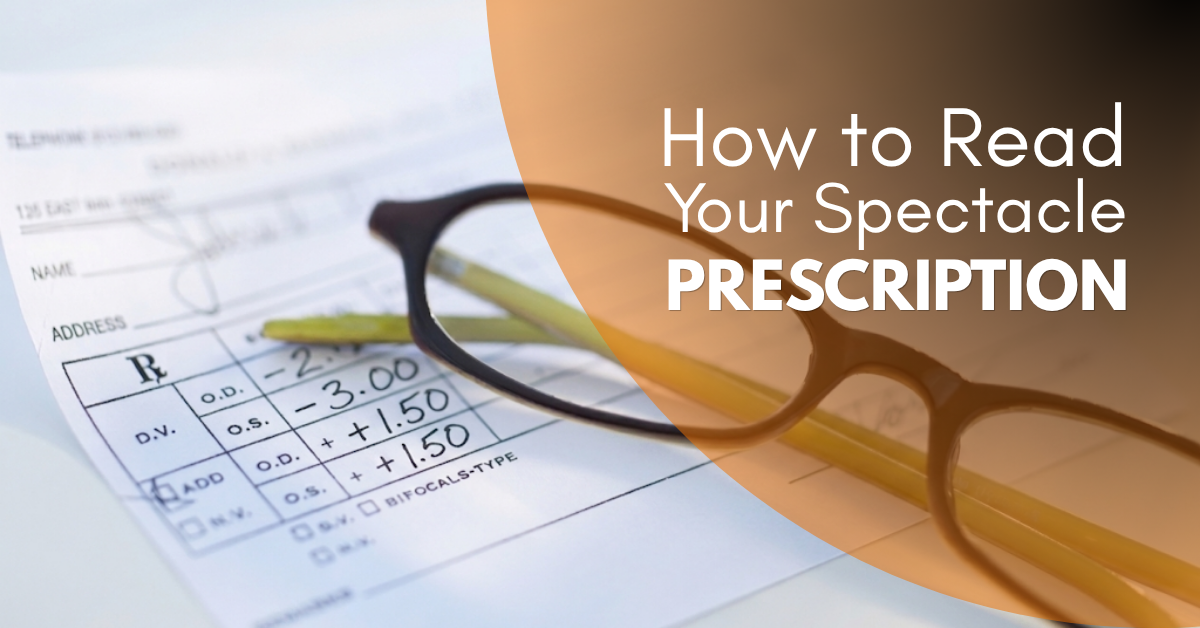
What does SPH mean? Why do I have a CYL number and an axis? Can I still wear contact lenses?
These questions come up in almost every eye clinic visit. The good news: once you know four terms, your prescription makes complete sense.
The 3 Parts of a Spectacle Prescription
Every prescription has three key headings — SPH, CYL, and Axis.
SPH (Spherical)
The main power needed to correct your vision. It can be plus (+) or minus (−).
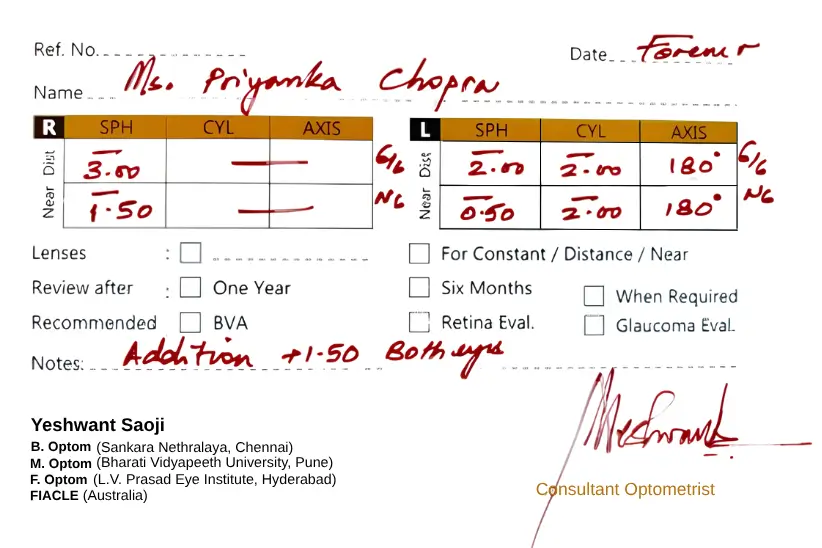
Example: Priyanka needs −3.00 D in her right eye.
CYL (Cylindrical)
An extra power added on top of SPH to correct astigmatism in one specific direction.
Example: Her left eye needs −2.00 D SPH with −2.00 CYL at axis 180. That means at axis 180, her power is −4.00 D, but at axis 90, it’s just −2.00 D.
Axis
This tells the doctor where to place the cylindrical correction — it’s a direction (1° to 180°), not a power. If you have CYL, you’ll always have an axis. That’s normal, not a bigger problem.
Near Power = Distance Power + Addition
After a certain age, reading up close needs extra “add” power.
Example: Priyanka, 45, is prescribed +1.50 D addition. Her near power becomes −1.50 D (right eye) and −0.50 D SPH with −2.00 CYL at axis 180 (left eye).
Understanding Distance Vision (6/6)
Vision is written as a fraction like 6/6.
- 6/6 = normal vision (you read at 6m what a normal eye reads at 6m)
- 6/12 = below normal (you must come to 6m to read what others read at 12m)
Understanding Near Vision (N6)
N6 is normal near vision. Any number higher than 6 (like N8, N10) means reduced near vision.
Key Takeaway
Reading your spectacle prescription isn’t complicated once you know what SPH, CYL, axis, distance vision, and near vision actually mean. Next time you get your eye check-up, you’ll understand your numbers instantly.